





5 minutes
A board member at a conference recently said to me, “Our board wants to be in more strategic conversations that include big decisions, like whether we enter a new market or introduce commercial lending. Otherwise, it’s not really a strategic discussion.”
To this director, weighing in on decisions that are both consequential AND new is table stakes for a “strategic discussion.” That view is common among boards: if the planning discussion centers on refining and executing strategies already in flight (and working), it somehow isn't “strategic enough,” or worse, the executives aren't “strategic.”
The allure of abstract mental territories and bold new ventures is an appealing challenge. Yet, when the premise of strategic planning is conditioned on presenting big, new ideas, management will get the message and organize to scratch that itch. We’ve seen this countless times: the executive team builds a list of big new projects and initiatives (i.e., new stuff) to bring to the planning session, each meant to boost performance and deliver more value. Those same teams will often admit behind closed doors that their pace and rhythm of execution isn’t as focused or aligned as it could be. Sound familiar? It’s challenging to be hyper-aligned and disciplined if the team is regularly introducing new ideas onto an unrefined operational engine.
In these scenarios, the most strategically consequential decision a board can make might also be the least provocative: choosing strategic discipline over bold new moves.
The Unfocused SWOT Trap
One of the most common ways “new stuff” bias sneaks into planning is through a well-intentioned SWOT analysis. Organizations frequently employ a Strengths, Weaknesses, Opportunities, Threats (SWOT) framework in their “strategic planning” meetings. This is an excellent module to organically capture and channel a broad set of perspectives in a short period of time. However, a common trap with this exercise is that it is set up without a focused frame and can end up generating too broad a conversation. Whichever topic is mentioned first (or loudest) then directs momentum for the majority of the conversation.
This popcorn style format encourages individual perspectives to then be shared, regardless of how informed or grounded they may be in the topic at hand. The premise of the dialogue is then built upon what participants can best contribute in the moment. The best idea off the top of someone’s head, or most assertively voiced, might not be the best idea for your organization.
Unintentionally, the momentum of the dialogue has carried the conversation down a tangent that isn’t substantively informed yet ends up cementing organizational priorities.
Core Competency vs. Competitive Advantage
To elevate strategic planning, boards must anchor conversations around a fundamental question: What truly makes our organization competitive?
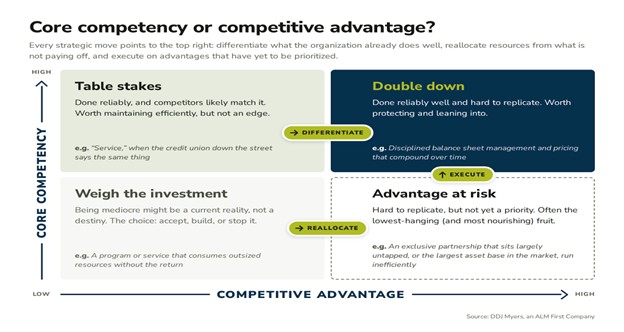
The most critical strategic conversation is often about how to deploy precious resources to exceptionally execute what is already in play. Doing this requires distinguishing between two concepts that are frequently conflated: Core Competencies and Competitive Advantages. Substantively defining and enumerating these for your organization can be extremely enlightening and strategically empowering
Core Competencies: Here’s where it gets uncomfortable, an “organizational core competency” is not necessarily something that is done well and it certainly is not singularly done by a key individual. The working definition we use with clients (and it tends to surprise people) is, “what an organization accomplishes on a regular basis with little effort or course correction from management.”
The most challenging part of this concept to embrace is that an institution’s core competencies might not be glorious accomplishments. Being mediocre in one business aspect is not always a design intent yet might be the reality; just as being exceptional at everything is unrealistic. The strategic conversation is to discern between the degree of effectiveness at organizational core competencies and what makes an institution more competitive and valuable to prospects.
Competitive Advantages: How we position this concept with clients is, “the aspects of a business that make it uniquely competitive in its market. These conditions would be difficult to replicate and put it in a favorable business position.”
The most frequent first-cited competitive advantage is “service,” which may be true. The mental challenge is to then imagine what the leadership of a competitor down the street might also first cite as their competitive advantage (likely service). After identifying the institution’s competitive advantages, the conversation then needs to shift to, “how fully are we leveraging these aspects of our business?” Said differently, more fully exploiting a competitive advantage might give the organization a distinguished and beneficial edge in the marketplace.
Competitive advantages run the gamut. For example, a unique charter, a well-positioned physical footprint, a strategic partnership with a recognized entity, or a first-rate tech stack are all aspects of a financial institution that are hard to replicate. Identifying under-expressed competitive advantages is as sobering as it is empowering. Also hard to swallow is that not every competitive advantage is a core competency (e.g., exclusively holding a strategic partnership that management poorly executes; or having the largest asset base in a market yet inefficiently operating) yet an exceptional core competency could be a competitive advantage (e.g., regularly nurturing a partnership with an exclusive strategic partner; or structured balance sheet management practices and pricing disciplines that create competitive efficiencies over the long term).
Decisive Architects of Strategic Priority
As the financial services landscape grows more unpredictable, the margin for error becomes less forgiving. The itch to discuss big and new strategies is certainly warranted but strategic governance requires discernment.
Before your next strategic planning session, consider putting a few different questions on the table:
- What does our organization accomplish regularly, with little effort or course correction from management (and is that where we want to be good)?
- If we asked the competitor down the street to name our competitive advantage, what would they say?
- Which of our competitive advantages are we under-leveraging today?
- What would it take to execute exceptionally on what is already in flight before we add something new?
Discerning between introducing new and cool stuff and doubling down on what already makes an organization competitive is the unique opportunity boards have as decisive architects of strategic priority. Sometimes the boldest strategic decision is to stay the course and violently execute.
Peter Myers is SVP at DDJ Myers, an ALM First company. DDJ Myers has been working with credit unions in a professional development capacity since 1989. The company has won awards for our innovative and impactful work across the country with organizations of all shapes and sizes. As part of its CEO succession planning process, executive search work, or strategy development and deployment programs, DDJ Myers deploys its organization alignment assessment, an instrument that provides stakeholders actionable insights about the organization’s strategic alignment and optimal readiness for future actions. The OAA has collected thousands of responses, so the data can now be considered across a variety of factors, including organization level, departments, tenure, race/ethnicity, and gender.
