




6 minutes
Leadership often reveals itself not in the moments we plan for, but in the moments we never would have chosen.
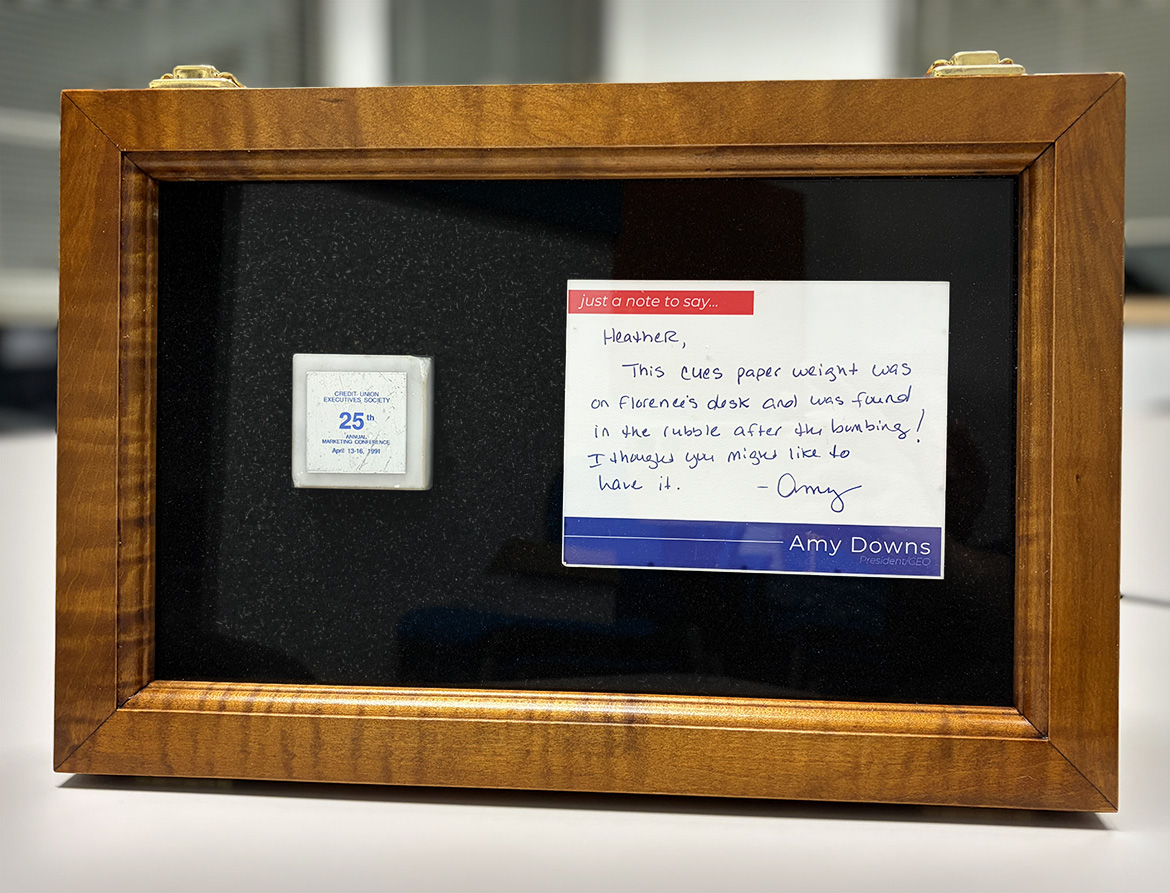
There is a small object displayed in the CUES office that stops people out of intrigue and curiosity.
It isn’t large. It isn’t polished. And at first glance, you might not recognize what it is. But once you know its story, you understand why it matters so deeply—not just to CUES, but to the credit union movement as a whole.
The object is a paperweight commemorating the 25th Annual CUES Marketing Conference in April 1991, which was gifted to Federal Employees Credit Union, now Allegiance Credit Union. It was recovered from the rubble of the Alfred P. Murrah Federal Building after the Oklahoma City bombing in 1995. In a space defined by unimaginable loss, it was one of the few tangible items salvaged. Then-CEO and bombing survivor Florence Rogers (who was also a 1995 CUES Hall of Fame inductee) preserved it, without knowing the impact it would have in the future.
Years later, it was passed to another survivor, Amy Downs, who would go on to lead Allegiance Credit Union as their third consecutive woman in the role of CEO. Amy was no stranger to CUES throughout her tenure, having completed all three years of CUES CEO Institute to earn her Certified Chief Executive (CCE) designation, and later named the 2017 CUES Exceptional Leader. Present day, Amy is a nationally recognized motivational speaker and author of Hope is a Verb, dedicating her time to telling her story of resilience and perseverance to inspire others.
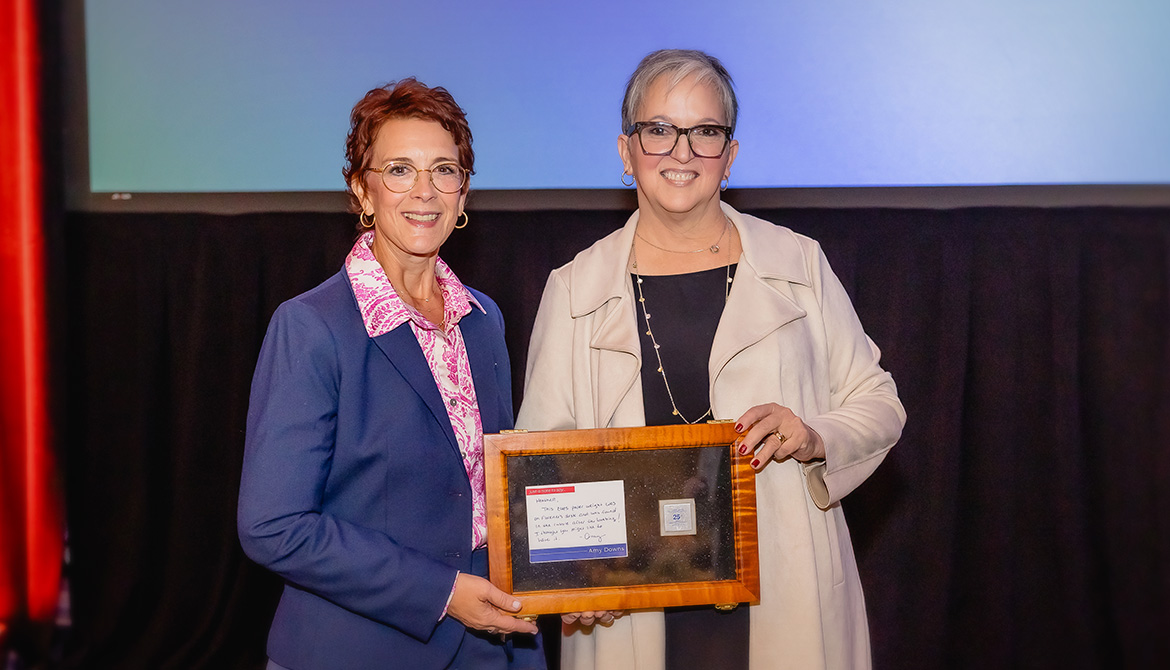
After Amy Downs and I were introduced more than 25 years following the bombing, she sent me the salvaged CUES paperweight.
It now sits in our office as a symbol of something enduring, and a reminder that leadership is ultimately defined by what we choose to carry forward.
The Leadership Reality We’re Living In
Leaders today are navigating a level of disruption that looks different from a single catastrophic event, but is no less demanding. Economic uncertainty continues to compress margins, while member expectations evolve toward personalized, digital-first experiences. Regulatory complexity expands, competition stretches beyond traditional peers, and organizations are being asked to invest in transformation while managing risk more carefully than ever.
Industry trends reflect what leaders already feel: consolidation driven by scale pressures, increasing technology costs, and the growing urgency of leadership succession planning. Disruption is no longer episodic; it’s structural, persistent, and layered.
That reality changes what leadership requires. It goes beyond navigating through one difficult period and returning to stability. Instead, leaders must learn to guide organizations through ongoing movement while maintaining clarity of purpose and continuity of culture.
Resilience is Not Recovery. It’s Orientation.
We often talk about resilience as the ability to bounce back, but leaders rarely have the opportunity to return to yesterday’s conditions. Markets shift, member expectations evolve, and competitive dynamics reshape the environment faster than organizations can simply restore what once worked.
Resilience today is better understood as orientation—how leaders interpret change, how they respond to ambiguity, and how they help their organizations stay anchored in purpose even as strategy evolves.
That paperweight in our office reminds me of this distinction every day. Florence Rogers preserved it because it meant something. Amy Downs carried that meaning forward, leading Allegiance Credit Union through remarkable growth and cultural transformation. Their choices illustrate that resilience is active leadership grounded in values and translated into action over time.
What the Memento Teaches About Leadership Today
That small piece of CUES history carries lessons that feel particularly relevant in today’s environment.
First, mission must outlast structure. Buildings, systems, and strategies change, but organizations that remain grounded in purpose navigate transformation differently. Credit unions that stay focused on serving members, strengthening communities, and developing people are able to adapt their models without losing their identity. Purpose becomes a stabilizing force, allowing leaders to make difficult decisions without drifting away from what matters most.
Second, leadership choices compound. Florence Rogers could not have known that preserving that paperweight would one day shape another leader’s perspective. Amy Downs could not have predicted that carrying its meaning forward would influence how she led through growth and change. Leadership rarely hinges on a single moment; instead, it unfolds through a series of decisions that shape culture, reinforce values, and ultimately determine outcomes.
Finally, leadership is inheritance work. That memento passed from one leader to another before arriving at CUES, and that journey underscores a truth that often gets overlooked: leaders are not only responsible for current performance, but for what they leave behind. Every decision, every investment, and every cultural signal shapes what the next generation of leaders will inherit.
The Skills Leaders Need Now
If disruption is structural rather than temporary, leadership development must evolve accordingly. Leaders increasingly need the ability to adapt strategy without destabilizing their teams, which requires clarity of purpose paired with flexibility in execution. When leaders consistently communicate why decisions are being made, people are better equipped to navigate how those decisions unfold.
Emotional steadiness is equally critical. Sustained uncertainty tests not just strategy, but stamina, and leaders who demonstrate emotional intelligence—by listening carefully, responding thoughtfully, and maintaining perspective—create environments where people remain engaged rather than overwhelmed.
Taking it one step further, leaders must help their organizations interpret change in a way that channels energy toward growth rather than fear. When disruption is framed as an opportunity to evolve rather than a signal of loss, organizations become more willing to experiment, learn, and move forward together.
Why This Story Matters Now
That memento in our office does not ask us to dwell on tragedy. Instead, it challenges us to reflect on responsibility.
The credit union movement was built on the belief that people helping people is more than a principle—it’s a leadership commitment that has allowed the system to endure through decades of economic cycles, technological change, and societal shifts. That endurance, however, is not automatic. It depends on leaders who are willing to evolve their strategies while remaining anchored in purpose.
Amy Downs often says that hope is a verb. For leaders, that means hope is not about optimism; it’s about action. It’s the choice to invest in culture when outcomes are uncertain, to develop people when resources feel stretched, and to continue building forward even when conditions are unsettled.
That small paperweight serves as a daily reminder that leadership is about deciding what matters enough to endure—and then building a future that carries those values forward.
Heather McKissick, I-CUDE, is CEO of CUES. Her 30-year not-for-profit career encompasses six different industry sectors. She is a former EVP at University Federal Credit Union, Austin, Texas, where she served for nine years. Prior to that, she was CEO of Leadership Austin, an organization dedicated to developing community and civic leaders across Central Texas. McKissick is the previous director of organizational development at one of the largest non-profit healthcare systems in the US and was an administrator and faculty member at St. Edward’s University.
