




10 minutes
Why Credit Union Boards May Be Missing the Bigger Climate Risk Story
It Didn’t Start as Climate Risk
At Meriwest Credit Union, the board wasn’t discussing climate risk that day. The discussion began with a mortgage.
A member with a strong credit history was suddenly struggling to obtain affordable homeowners’ insurance. Following a series of wildfire-related reassessments in California, available carriers had narrowed, premiums had increased substantially, and coverage options were becoming increasingly limited. What initially appeared to be a member service issue quickly evolved into a lending issue, a portfolio issue, and ultimately a strategic issue.
The conversation soon moved beyond a single borrower. If insurance became increasingly difficult to obtain in certain markets, what would that mean for future mortgage originations? How might it affect collateral assumptions? Would some communities become more difficult to serve? Could changing insurance dynamics influence long-term portfolio growth?
The board was not debating climate science. It was discussing lending, risk, member service, and strategy. Yet each question traced back to the same underlying issue.
The discussion prompted Meriwest’s leadership team to step back and ask a broader question: Was this an isolated challenge, or was it part of a larger pattern affecting credit unions more broadly?
That question became the foundation for a multi-institution research project involving interviews and structured discussions with credit union executives and directors, including conversations conducted during the National Credit Union Marketing Association (NCUMA) Conference. Findings from this work are scheduled for publication in the July 2026 issue of the Journal of Behavioral and Applied Management.
What emerged from those conversations was both surprising and remarkably consistent. Nearly every executive we interviewed could identify examples of emerging risk affecting their institution. Yet very few had intentionally connected those experiences into a broader governance discussion.
The risks were being managed.
The pattern was not.
What We Heard from Credit Union Leaders
When executives described the challenges facing their institutions, they rarely used the phrase “climate risk.” Instead, they spoke about insurance instability affecting lending decisions, vendor disruptions that tested business continuity plans, infrastructure vulnerabilities, member hardships following natural disasters, and uncertainty regarding long-term community resilience.
One executive described growing concern over insurance availability in portions of the institution’s lending footprint. Another discussed severe weather events that disrupted critical vendors and created operational challenges. Others pointed to local economic disruptions that strained members and small businesses in ways traditional risk models had not anticipated.
What made these conversations particularly noteworthy was that they occurred regardless of geography, asset size, or leadership perspective.
The examples varied.
The pattern did not.
Across institutions, leaders were encountering these exposures through existing business functions. Most organizations were addressing the individual symptoms effectively, but few were examining the larger pattern emerging across lending, operations, technology, strategy, and member service. As a result, many risks that appeared unrelated were connected manifestations of the same broader trend.
This distinction matters because emerging risks rarely arrive as clearly labeled categories. A board may believe it is discussing insurance, vendor resilience, community development, infrastructure investment, or portfolio management when it is actually encountering different expressions of the same underlying challenge.
Why Traditional Risk Frameworks Miss the Pattern
Credit unions have developed sophisticated approaches for managing risk. Credit risk, liquidity risk, cybersecurity risk, compliance risk, operational risk, and vendor risk all receive regular attention from management and boards. Those frameworks provide accountability, structure, and oversight.
The challenge is that many emerging risks do not respect organizational boundaries. What begins as an insurance issue can quickly become a lending issue. A lending issue can affect portfolio quality, which in turn influences growth strategy. A vendor disruption can become a business continuity challenge, while a community disruption can affect member financial health, loan performance, and long-term economic development simultaneously.
Traditional governance systems tend to evaluate these issues separately because they emerge in different departments. By the time the connections become obvious, institutions may already be reacting rather than anticipating. The issue is not that boards lack information. The issue is that the information often arrives in disconnected pieces.
Introducing the Connected Risk Lens
This observation led us to what we call the Connected Risk Lens.
The Connected Risk Lens is a governance framework that helps boards identify and manage interconnected risks that may otherwise appear as isolated operational, strategic, or financial issues.
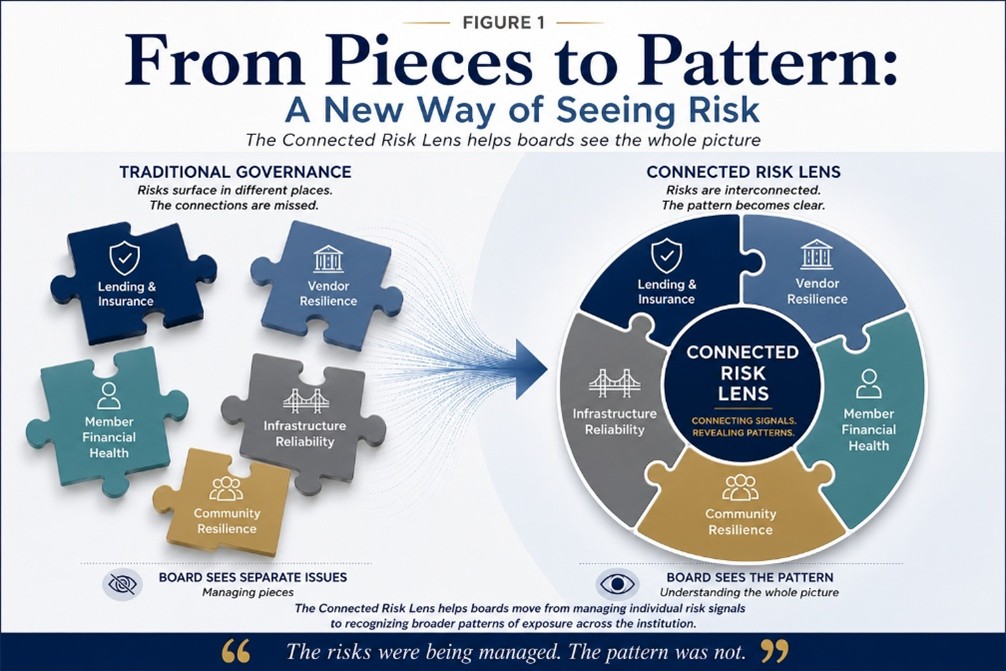
As illustrated in Figure 1, the Connected Risk Lens encourages boards to move from managing individual risk signals to understanding the broader patterns those signals may collectively represent. Rather than creating a new category of risk, it provides a new way of understanding risks that already exist by revealing how developments in one area of the organization can influence outcomes in another.
Under this approach, boards and executive teams look beyond individual incidents and ask how risks influence one another across the organization. Insurance availability affects lending. Lending affects portfolio quality. Portfolio quality influences growth strategy. Growth strategy affects reputation. Vendor resilience affects operational continuity. Community resilience affects member financial health.
Viewed independently, each issue appears manageable. Viewed together, they reveal a broader pattern of exposure.
The value of the Connected Risk Lens is not that it predicts the future. Its value is that it helps boards recognize patterns earlier. Directors rarely suffer from a lack of information; more often, they struggle with information arriving in disconnected pieces. The Connected Risk Lens helps connect those pieces before they become larger financial or strategic challenges.
A Second Story: When Opportunity Becomes Risk
One participating credit union in our research saw an opportunity in renewable energy lending. Demand was increasing, members were interested, and the initiative aligned well with the institution’s strategic objectives. To accelerate growth, the credit union partnered with a fintech provider specializing in solar financing.
Initially, the partnership appeared successful. Loan volume increased, member interest was strong, and the program supported the institution’s broader growth strategy. Then the partner failed. Projects were left unfinished, member concerns escalated, and operational challenges emerged. Management ultimately spent significant time and resources protecting member relationships and resolving issues that had not been anticipated at the outset.
At first glance, this appeared to be a vendor management problem. Viewed through the Connected Risk Lens, however, the situation looked very different. The event sat at the intersection of strategy, technology, operations, reputation, and market transition. What appeared to be a single failure was multiple forms of risk interacting simultaneously.
The lesson was not that innovation should be avoided. Rather, it demonstrated how emerging opportunities often carry interconnected risks that traditional governance frameworks may not fully capture. When risks are evaluated independently, important relationships may remain hidden until an event exposes them.
Why Boards Should Care
For boards, the significance of this discussion extends well beyond climate-related concerns. The larger issue is governance.
Most directors are accustomed to reviewing risk through categories. Board packets typically include updates on credit quality, liquidity, cybersecurity, compliance, operations, and strategic performance. Each category deserves focused oversight and remains an important component of effective governance.
The challenge is that emerging risks rarely arrive in neat categories. Instead, they move through organizations in ways that cross departmental boundaries and unfold over longer time horizons. As a result, institutions may be effectively managing individual symptoms while overlooking the broader pattern connecting them.
One of the clearest findings from our interviews was that many impacts entered board discussions indirectly. They appeared as insurance challenges, lending questions, infrastructure concerns, vendor issues, or community development topics. Rarely did they arrive labeled as climate risk. Yet in many cases, those discussions reflected different manifestations of the same emerging trend.
This creates a governance blind spot. Boards may believe they are discussing separate operational issues when they are observing interconnected exposures. The Connected Risk Lens encourages directors to ask a different question:
What patterns are emerging across the institution that we may currently be treating as unrelated events?
That question alone can elevate the quality of board discussions by shifting attention from isolated events to broader patterns of exposure.
Moving From Reaction to Recognition
Importantly, adopting the Connected Risk Lens does not require sophisticated climate models, specialized consultants, or extensive new reporting systems. It begins with awareness and a willingness to look beyond traditional organizational boundaries.
Lending teams, operations teams, technology leaders, risk managers, and executives often see different pieces of the same story. When those perspectives remain isolated, meaningful patterns can be difficult to recognize. When those perspectives are brought together, emerging risks become easier to identify and address.
The objective is not prediction. The objective is recognition.
The most resilient institutions are rarely those that forecast the future perfectly. More often, they are the organizations that recognize meaningful trends early enough to adapt. By helping boards connect information that might otherwise remain fragmented, the Connected Risk Lens improves visibility into risks that are already present but not yet fully understood.
A Leadership Opportunity
Credit unions occupy a unique position within the financial services industry. Because they are deeply connected to the communities they serve, they often experience local disruptions before those disruptions become visible in broader economic data. At the same time, their cooperative structure and member-focused mission position them to respond in ways that strengthen long-term relationships and community resilience.
Several executives we interviewed emphasized that community resilience has become an increasingly important consideration in strategic planning. While the terminology varied, the underlying concern was consistent: economic, environmental, and social disruptions can influence members in ways that traditional risk models may not fully capture.
This presents an opportunity for boards and executive teams. Rather than viewing climate-related issues as a separate agenda item competing for board attention, directors can view them through the Connected Risk Lens—as factors that influence risks which they are already responsible for overseeing. Doing so allows these considerations to become integrated into existing governance processes rather than treated as a standalone initiative.
From Pieces to Pattern
The central finding from our research is straightforward: credit unions are already managing climate-related financial risk. They simply are not managing it as a connected system.
The institutions we studied were not ignoring these risks. In fact, most were responding thoughtfully and effectively to the challenges they encountered. What was often missing was a framework for connecting those experiences into a broader understanding of risk.
The Connected Risk Lens provides that framework. It encourages boards and executive teams to move beyond individual events and consider how risks interact across lending, operations, technology, strategy, reputation, and community resilience. By helping leaders move from managing individual issues to recognizing broader patterns of exposure, the framework strengthens governance without requiring organizations to abandon existing risk-management practices.
Ultimately, this is not about environmental policy. It is about governance. It is about understanding how emerging risks move through organizations, communities, and balance sheets. Most importantly, it is about ensuring that boards are seeing the full picture.
The risks were being managed.
The pattern was not.
The Connected Risk Lens helps boards see both.
Interviews with credit union executives revealed a consistent pattern: institutions were experiencing risk signals across lending, operations, vendor management, member service, and strategy, yet few viewed those signals as part of a connected system. The Connected Risk Lens helps boards move from managing individual issues to recognizing broader patterns of exposure.
Read Global Risk and Resilience in Sustainable Climate Finance: Behavioral, Financial, and Governance Implications for Financial Institutions in the July 2026 issue of the Journal of Behavioral and Applied Management.
Five Questions Every Credit Union Board Should Ask
1. What issues are appearing in multiple areas of the organization at the same time?
2. Where might we be treating interconnected risks as separate events?
3. Which assumptions about our members, communities, or markets deserve reexamination?
4. How resilient are our critical partners, vendors, and supporting infrastructure?
5. What emerging patterns could materially affect our institution over the next five to ten years?
Dr. Arthur L. Jue, DM, CCD, is Chairman of Meriwest Credit Union and CEO and Co-Founder of LiveFreely Inc. He has more than 30 years of leadership experience spanning financial services, technology, healthcare, and governance.
Dr. Udey Chaudhry, DBA, is a Director of Meriwest Credit Union, where he chairs the Governance Committee. He is also a senior leader in a top tier consulting firm, as well as an educator and researcher specializing in business strategy, innovation, digital transformation, and organizational leadership.
