



12 minutes
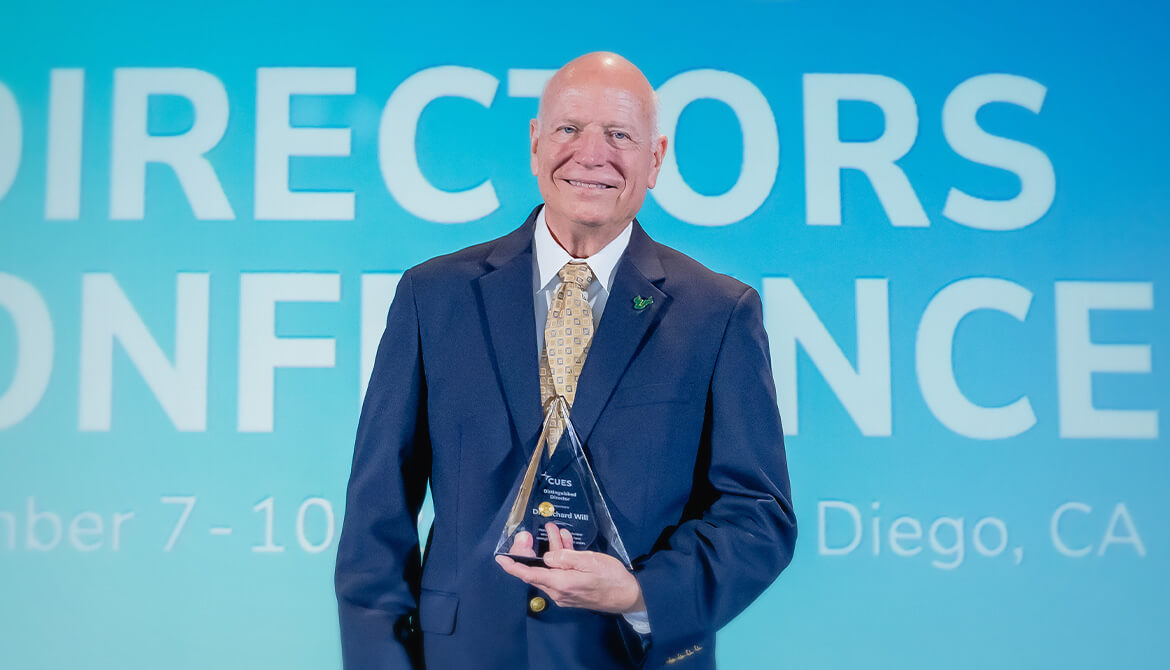
Dr. Rick Will, 2025 CUES Distinguished Director, Has Sought to Improve Lives Through His Dedication to Volunteerism
When Dr. Rick Will was approached in 2008 about becoming a volunteer for USF Credit Union, headquartered in Tampa, Florida, there was one overriding reason why he said yes: He believed he could make a difference. “That has been a central theme in my life,” he said. “I’ve always wanted to make a difference.”
Certainly, he has achieved this goal as a USF CU volunteer over the last 18 years, half of that time as board chair. In this role, Will works tirelessly to keep the board engaged. He has leveraged his extensive business background as a professor at University of South Florida Muma College of Business for the betterment of the credit union. Additionally, he is an exceptional leader who understands the importance of working collaboratively and achieving consensus. Those traits and more earned him the title of 2025 CUES Distinguished Director, an award that recognizes a board member who has made outstanding contributions to their credit union and/or the industry.
“Dr. Will exemplifies what it means to be a truly distinguished director,” said USF CU’s President/CEO Richard J. “Rick” Skaggs, who has worked closely with Will for more than 12 years. “His thoughtful leadership, strategic mindset, and unwavering commitment to our mission have made a lasting impact on USF Credit Union.”
One of Will’s most meaningful contributions has been transforming how the board approaches strategic planning. “Through his leadership, we adopted the Harvard Business School case method—a dynamic framework that brought clarity, critical thinking, and deeper engagement to the boardroom,” Skaggs said. “This approach has fundamentally elevated our strategic discussions and continues to guide our organization with greater alignment and long-term vision. His work in this area was even recognized in a 2021 article in CU Management, highlighting how innovative governance practices can drive real organizational impact.”
Skaggs praised Will for elevating board governance at USF CU, particularly in the way he champions innovation while fostering a culture of collaboration and accountability. “We are proud to see him recognized with this well-deserved honor and are deeply grateful for the lasting value he brings to our organization,” he said.
An Impactful Contribution
Will started out at USF CU as many credit union volunteers do—by serving on the supervisory committee. Three years later, he filled an opening on the board and has served continuously ever since. During his nine years as chair, USF CU has more than doubled its assets from $600 million to $1.4 billion and seen strong membership growth of nearly 30% to over 75,000 members.
When Will was initially approached about becoming a USF CU volunteer, he actually declined. He felt that his professorial duties would keep him far too busy to contribute effectively. Plus, he was already involved in several volunteer causes, most notably as a multimedia developer of educational programs for the Jimmy Carter National Historic Site Education Program.
In the hopes of changing his mind, long-time USF CU board member Willie Stokes stopped by Will’s office to make a personal appeal. He told Will that he had looked at his background, his leadership skills, and his business expertise. “I really think it would be beneficial to our credit union and our membership if you would be a volunteer,” Stokes told him. Though Will was listening, Stokes hadn’t quite closed the deal.
“Then he said those magic words: I really think you can make a difference,” Will recalled. “As soon as he said that, I was hooked.”
Will echoed Skaggs’ assessment that one of his most impactful contributions has been in reinventing the board’s approach to strategic planning. He credits his mentor, Dr. Grandon Gill, a Harvard-educated colleague, for bringing the HBS method to his attention and helping him see the potential for taking it beyond the classroom into business-like settings.
To kick off the strategy planning process each year, Will takes on the Herculean task of developing a discussion case that summarizes USF CU’s challenges and opportunities for the coming year. The discussion case consists of a multi-page narrative, financial charts, and strategic directives for the board to consider. Will draws on data from several sources both within and beyond the credit union industry.
The board, supervisory committee, and senior management use the discussion case to develop a prioritized list of strategic objectives to pursue in the coming year. “The list is reviewed by all the volunteers on the board and the supervisory committee,” Will said. “We boil it down to a single page. Every volunteer reviews the document, and if there are changes, I revise it until we get a consensus from the entire set of volunteers.”
One year, the goals identified by the board fell into four categories: growth, risk management, planning, and process improvements. “Over the last two years, we’ve been focusing on deposit growth, tracking viable mergers and acquisitions, continuing our strong concierge program, better defining our membership, and understanding their needs and expectations,” Will said.
An Indispensable Tool
When the board first began using the HBS method in 2013, it was intended to be a biennial effort. However, it became such an indispensable tool that Skaggs requested that the board provide it every year. It’s been an annual process since 2019, with a few tweaks and modifications along the way. Will observed that the method could be used quite effectively at other credit unions.
“We’d like to get a how-to out there for others to use with those modifications, because we haven’t found anything like it anywhere,” Will said. “We think other credit unions would benefit because it really builds great synergy between management and the board.”
While the process is time-consuming for Will, he stressed that the results are worth the effort—and it again goes back to his goal of making a difference. “I’ve been told by the senior leadership team that it really does have an impact,” he said. “They depend on it to guide them, and it’s a far better process for strategic planning than we had before. We as the board come to them as one voice instead of 13 different voices.”
As board chair, Will also has been instrumental in implementing other important procedures at the credit union. For instance, he just finished designing and leading a Risk Appetite Exercise with the board, as required by the NCUA. “I designed a questionnaire and used a Delphi technique to get everybody’s opinion and achieve consensus,” he explained. “We kept it at a very strategic level and then turned the information over to management so they could operationalize it.”
The board continually strives to improve its effectiveness by conducting annual peer evaluations. Through these evaluations, board members can assess what they are doing to contribute to the credit union and whether they are staying sufficiently engaged.
“We absolutely fit the definition of an engaged board,” Will said. “The directors are demanding, but I want them to be demanding. My job is to determine the expectations of the board so that I can relay that to management. It’s not my voice that I need to convey. It’s the board’s voice. So, I want to make sure I understand their point of view.”
From Texas to Florida
Will has lived and worked in the Tampa area for nearly 40 years, but he was born and raised in Texas. After graduating from high school, he joined the U.S. Marine Corps, eventually obtaining the rank of sergeant. He had strong technical and analytical skills, which led to an assignment in Nicosia, Cyprus, working in classified communications. “I was reporting to the NSA at 20 years old,” he recalled.
Will served in Cyprus in 1973-74 but had to evacuate with the rest of his unit in spring 1974, shortly ahead of the Turkish invasion that was precipitated by a Greek-backed military coup. “We had to leave the island in a hurry,” Will recalled.
From there, Will was deployed to Adak in the Aleutian Islands of Alaska. The climate there was brutal, to say the least. “I tell people who look at photos of me in Adak, you can tell when it was summer because my parka is halfway unzipped,” he joked.
Having completed his stint in the military, Will decided he could secure a better future by getting a higher education. He enrolled in the University of Houston, where he obtained a bachelor of science degree in engineering technology from the University’s Cullen College of Engineering. He worked in the petroleum industry for 10-plus years, most notably as a systems manager for Occidental Petroleum Corp. At the same time, he pursued higher degrees at the University of Houston, switching to the C.T. Bauer College of Business and obtaining an MBA and Ph.D. in Information Systems.
At this point, Will had a decision to make. Should he stay in the oil and gas industry, where a career path was already mapped out for him? Or should he pursue a career in academia? Again, his desire to make a difference prevailed, which is how he began his career at USF Muma College of Business. He took on a role as assistant professor in 1988 and retired in 2020 as associate professor of Information Systems. After a year, he was back on a part-time basis working with DBA candidates during their dissertation phase. Many of the candidates were high-level executives affiliated with some of the nation’s largest and most well-known organizations. He is now Professor Emeritus at USF.
Important Contributions
Sharing his business skills with USF CU has contributed to a well-functioning credit union. During his tenure as chair, the credit union has received several awards that are a testament to good management and good governance. In 2020, the credit union was the recipient of the Florida Governor’s Sterling Award, which recognizes performance excellence. USF CU won the award after a years-long effort to streamline its systems and processes, resulting in better service for its members. Five years later, the credit union received the 2025 Governor’s Sterling Sustained Excellence Award in recognition of its ability to sustain its high performance for the long term.
This type of performance excellence provides a positive environment for USF CU’s 100-plus employees. For the past two years (2024 and 2025), the credit union was recognized as a USA Today Top Workplace. Will attributes this recognition to the credit union’s great culture, driven by the EPICC core values of excellence, passion, innovation, community, and collaboration. “The board had a role in identifying the core values for our credit union,” Will said. “We look at those values every year. It’s what has helped define our culture.”
While USF CU values its employees, Will stressed that members are the top priority at the credit union. “Our board, and I would say our entire set of volunteers, has a membership-first focus,” he said. “Every decision that the board makes always considers, ‘Is this in the best interest of our membership?’”
Complementing the member-first focus at USF CU is a commitment to helping the community. In 2022, the credit union took a big step forward in this commitment by becoming certified as a community development financial institution (CDFI), which provides access to the CDFI fund of federal dollars to spur economic growth and opportunities in low-income communities. Will was directly involved in pursuing CDFI certification through his connections at USF.
Dedication to Volunteerism
Volunteerism is inherent in Will’s desire to make a difference in the world. That extends to causes beyond the credit union. One of Will’s most rewarding volunteer experiences was his work from 1998 to 2017 on behalf of Jimmy and Rosalynn Carter that utilized his skills in multimedia applications.
His initial project involved development of an interactive exhibit called “President and Mrs. Carter Meet the Kids,” created for the Jimmy Carter National Historic Site Education Program. The program entailed the Carters answering frequently asked questions from children. Will’s background in computer graphics was instrumental in giving the exhibit the visual excitement that a previous iteration of the program was missing.
Will recalled that President Carter was extremely engaged in the project. The former president stopped by the Plains High School Museum one day in 2000, giving Will the opportunity to show him the prototype of the project. He had President Carter’s undivided attention for the better part of an hour, which is an unusually long time for a former president to carve out of his day. “He liked the project so much that he suggested it would be great to include at the Presidential Library as well,” Will said.
Other noteworthy contributions included development of an online virtual tour of President Carter’s Boyhood Home & Farm, which remained in use for over a decade.
Will’s volunteerism extends to other parts of his life as well. For the past 16 years, he has volunteered playing drums in his church’s Praise Band. A love for music runs in his family. He has guitar amps, keyboard, an electronic drum system, and a PA system set up in his living room, and it’s not unusual for family members to gather during the holidays to play, jam, and sing. He and his wife, Joni—married since 2009—have a wonderful, blended family. He has two daughters, two sons-in-law, three stepsons and their wives, two grandsons, and a granddaughter. One of his grandsons shares Will’s love of drumming, playing the instrument in his high school band.
Outside of his musical interests, Will is an avid do-it-yourselfer with an affinity for landscaping and woodworking. He also likes to travel internationally, with Europe being a favorite destination. In 2025, he took a trip to Germany, which brought back fond memories of when he taught a course at Osnabrück University nearly 20 years ago.
For 2026 and beyond, Will is looking forward to continuing to contribute his time to the credit union and other causes that are near and dear to his heart. “At this point, I’ve become comfortable with the idea of volunteering,” he said. “One of the top criteria for finding a good volunteer is to choose someone who already has a history of volunteering. We already know what it entails and what the commitment is. We also know the rewards. I’m not referring to monetary rewards, since board members of federal credit unions are not paid. But being a volunteer for a credit union is rewarding in so many other ways.”
Based in Missouri, Diane Franklin is a longtime contributor to CU Management.
