




5 minutes
Can You Prove It?
If you sprain your ankle and go to the doctor, there's a clear workflow. They diagnose the injury. They prescribe a treatment plan, taking into account your work schedule, your insurance, your ability to rest. They deliver the treatment. And at your follow-up appointment four weeks later, they measure whether your condition improved.
The entire process writes to a single record (your electronic medical record, or EMR), so everyone involved can trace the arc from diagnosis through outcome. Your doctor doesn't have to guess what happened between visits; the infrastructure connects the dots.
Now ask yourself: if a member walks into your credit union financially struggling, do you have anything close to this?
The Commitment Is There, But the Connective Tissue Is Missing
Most credit unions have financial health in the strategic plan.
Many have built real pieces: a budgeting course, a coaching program, an emergency loan product, community partnerships. Dedicated staff doing important work every day.
But when the board asks, "We've made the investments. We've committed to financial health. Is it working?" the room goes quiet.
Not because nobody's working hard. They are! But because the pieces aren't connected. The education team runs programs. The lending team builds products. The data team pulls reports. Nobody can trace a line from "this member was struggling" to "we connected them to the right resource" to "here's what changed."
Research from the Financial Health Network shows that 80% of members expect their financial institution to help improve their financial health. Only 14% feel it delivers.
The gap isn't effort or intention, but infrastructure.
The Four-Beat Loop
Every credit union I've talked to that's actually operationalizing financial health—not just talking about it—independently discovers the same loop. It has four beats:
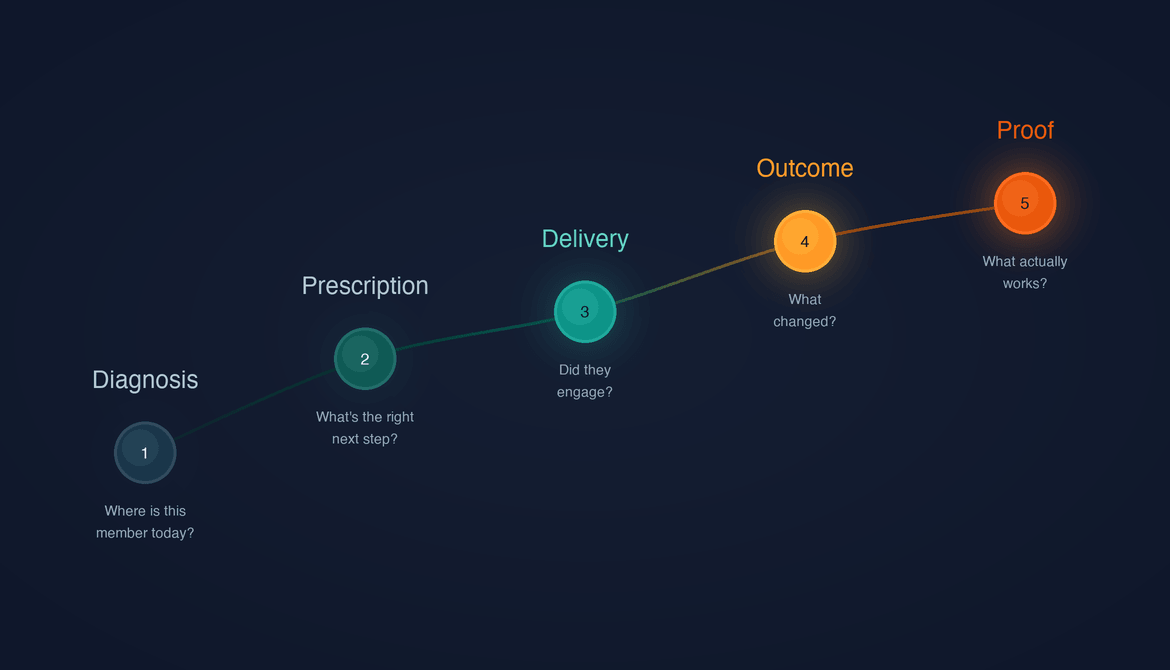
Diagnosis. Where is this individual member right now? Not a satisfaction survey or NPS as a proxy. An actual assessment of their financial condition across the dimensions that define financial health: spending, saving, borrowing, planning. Can you measure it today, and can you measure it again six months from now using the same instrument?
Prescription. Given what you now know about this member, which of your resources is the right next step? Coaching, education, a specific product, a referral to a community partner? Without this connection, you're offering the same thing to everyone regardless of where they are. A member drowning in credit card debt and a member sitting on six months of emergency savings don't need the same next step.
Delivery. Did the member actually engage with what you recommended? A prescription only helps if the person actually takes it. This is where most loops break; the recommendation exists on paper, but nobody tracks whether it was delivered, received, or acted on.
Outcome. When you follow up, using the same instrument you used for diagnosis, did this member's financial condition change? Not "did they attend a workshop" or "did they open an account," but "are they measurably doing better than they were before?"
And then a fifth beat emerges, one that only becomes possible when you have the first four in place: Proof. In aggregate, across your entire membership, what actually works to improve financial health? How do those improvements connect to the business metrics your board cares about?
This is the same architecture hospitals rely on. Clinical workflows write to electronic medical records. The EMR didn't make medicine possible (doctors practiced medicine for centuries without one), but it made medicine connectable. It lets you trace from diagnosis through treatment to outcome, at scale, for millions of patients.
Financial health needs the same backbone.
What This Looks Like in Practice
Virginia Credit Union built this loop. Cherry Dale, VACU's Senior Vice President of Financial Education, had been running financial health programming for years: education events, coaching, community partnerships, university integrations. What changed was adding measurement infrastructure that connected the pieces into a single traceable arc.
VACU started with diagnosis. They used the Financial Health Network's FinHealth Score, a validated instrument that segments members into Healthy, Coping, and Vulnerable tiers across four pillars: Spend, Save, Borrow, and Plan. Then they connected that diagnosis to their programming, from Women's Financial Success Summits to foster youth education to 1-on-1 coaching.
When they measured outcomes, the data told a clear story:
Across VACU's membership, financially healthy members hold 3.3 products on average. Vulnerable members hold 2.5. That's 32% more products. But the type of product shifts too. Healthy members are far more likely to hold CDs, high-yield savings, money markets, and mortgages. Vulnerable members over-index on personal loans and auto loans. Financial health doesn't just predict engagement—it predicts where a member sits in your product ecosystem and what kind of revenue they generate.
For targeted programs, the results were even sharper. VACU's foster youth "FE for Life" program, a six-session financial education series for young people aging out of foster care, moved participants from 3.3% scoring as Financially Healthy before the program to 22.6% after. That's a 19-percentage-point improvement in the population most financial institutions struggle to reach at all.
This is what proof looks like. Not "we ran a program," but "we can show you what changed, for whom, and how it connects to the business."
Where to Start
The four-beat loop is simple to describe and hard to build. But you don't have to build it all at once.
Ask yourself: which of the four beats can your credit union do today? Where does the loop break? Is it:
- Diagnosis—you don't have a validated way to assess individual member financial health?
- Prescription—you have the data, but can't connect it to the right next step?
- Delivery—recommendations exist, but you can't track whether members engage?
- Outcome—you can't measure change over time for the same individual?
Where your loop breaks is where to focus first. That's Monday morning's conversation with your team.
Andy Bandyopadhyay is the CEO of Attune, the Financial Health Network's exclusive technology partner for FinHealth Score implementation. Born and incubated inside FHN, Attune helps credit unions and financial services institutions connect financial health diagnosis to action to proof. Andy is obsessed with making it easier for institutions to help all of us get financially healthier.
